What is Impression Share in Google Ads?
Short answer: Impression Share (IS) is the percentage of eligible impressions your ads actually received. 70% IS means your ad showed in 7 out of every 10 auctions you could have entered. The other 30% was lost to either budget limits or low ad rank.
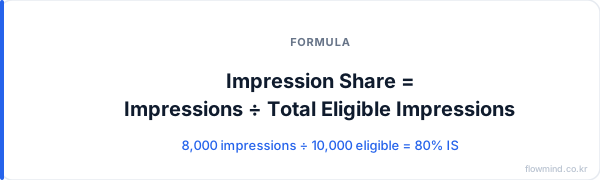
Use this diagram on your site (free): copy the embed code below — a credit link back to FlowMind is appreciated.
The two types of lost impression share
Google Ads breaks down your lost impression share into two diagnostic buckets. Understanding which one applies to you determines the fix:
- IS Lost (Budget) — your ads stopped showing because your daily budget was exhausted before all eligible auctions ran. Fix: increase your daily budget, or tighten targeting to reduce wasted spend on low-intent clicks.
- IS Lost (Rank) — your ad rank was too low to win the auction, even though you had budget remaining. Fix: improve Quality Score, raise your bids, or improve landing page experience.
You can see both columns in your Google Ads campaign or ad group view by adding them as custom columns.
What is a good impression share?
- Branded keywords: 90–100%. If competitors are bidding on your brand name and winning impressions, that’s a serious problem.
- Core non-branded keywords: 60–80% is a realistic target for competitive markets. Pushing above 80% on very competitive terms often requires disproportionate bid increases.
- Long-tail keywords: 80–95% is achievable because competition is lower.
Why impression share matters
Low IS means you’re visible to only a fraction of potential customers who searched for your keywords. If your IS is 40% on your top converting keywords, you’re leaving 60% of that traffic to competitors. At scale, low IS on high-intent keywords directly translates to missed revenue.
IS is also a useful efficiency signal. If your IS is high (85%+) but CPA is still high, the problem is conversion rate or offer — not traffic volume. If IS is low, you’re not even reaching all available buyers yet.
Impression share vs search top IS vs absolute top IS
- Impression Share (IS) — % of all eligible auctions where your ad showed anywhere on the page
- Search Top IS — % of eligible impressions where your ad showed in the top positions (above organic results)
- Search Absolute Top IS — % of eligible impressions where your ad was the very first ad shown (position 1)
For most campaigns, optimise for overall IS and CPA rather than chasing absolute top position. Position 1 is the most expensive and doesn’t always produce the best CPA.
How to improve impression share
- If IS lost to budget is high: Increase daily budget, narrow targeting to highest-value keywords, or add negative keywords to reduce wasted spend
- If IS lost to rank is high: Improve Quality Score (ad relevance, landing page), raise bids on your best-performing keywords, or use Target Impression Share bidding for branded terms
- Reduce portfolio breadth: Running 200 keywords with a small budget spreads IS thin across all of them. Concentrate budget on 20–50 high-converting keywords to maximise IS where it matters.
Common mistakes
- Trying to maximise IS on all keywords equally. Not all keywords are worth fighting for. Focus IS improvement on keywords with proven conversion history.
- Using Target Impression Share bidding on conversion campaigns. This strategy optimises for visibility, not conversions. Use Target CPA or Target ROAS for performance campaigns instead.
- Confusing IS with reach. High IS doesn’t mean you’re reaching your whole target market — it just means you’re capturing most of the search demand that already exists for your keywords.
FAQ
Where do I find impression share in Google Ads?
In Google Ads, go to Campaigns or Ad Groups view, click the columns icon, and add “Impression Share,” “IS Lost (Budget),” and “IS Lost (Rank).” These are not visible by default.
Does impression share affect Quality Score?
Indirectly. A low IS lost to rank signals low Ad Rank, which is connected to Quality Score and bids. Improving Quality Score raises Ad Rank, which reduces IS lost to rank and increases total IS.
Is 100% impression share a good goal?
For branded keywords, yes. For competitive non-branded keywords, chasing 100% IS typically requires extreme bids and produces diminishing returns. Focus on hitting your CPA target at the highest IS your budget allows.