What is average order value (AOV)?
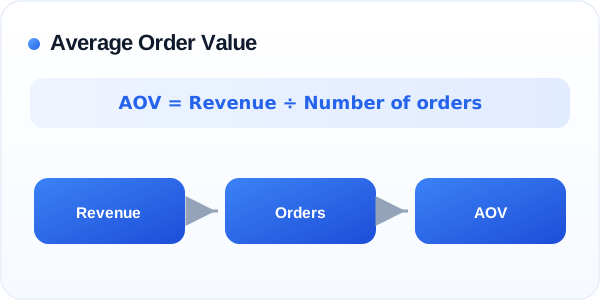
In short: AOV is the average amount a customer spends in a single order. AOV = total revenue ÷ number of orders. Because it feeds profit per order, raising AOV directly increases how much you can afford to pay for a click.
AOV is one of the three levers behind break-even CPC, and it is often the easiest to move without touching your ad account. A higher AOV means each order carries more profit, which means each click is worth more, which means you can win more auctions.
How to raise AOV
- Bundles, package complementary products at a slight discount.
- Free-shipping thresholds, “spend $X for free shipping” nudges basket size up.
- Upsells and cross-sells, offer the upgrade or add-on at checkout.
Watch margin while you do it: a discount that lifts AOV but guts margin can leave your break-even CPC unchanged. Test the combined effect in the break-even CPC calculator.
A worked example
Say a store does $48,000 in revenue across 600 orders in a month. AOV = $48,000 ÷ 600 = $80. At a 50% gross margin, each order carries $40 of profit. If the store converts 2% of clicks, its break-even CPC is $40 × 0.02 = $0.80.
Now lift AOV to $96 with a bundle and a free-shipping threshold, holding margin and conversion rate steady. Profit per order rises to $48, and break-even CPC climbs to $48 × 0.02 = $0.96, a 20% bigger bid ceiling, won without touching the ad account. That is why AOV is the lever to pull before you fight for cheaper clicks.
AOV vs the averages it gets confused with
| Metric | Formula | Counts |
|---|---|---|
| AOV | Revenue ÷ orders | Per single order |
| Revenue per customer | Revenue ÷ customers | All orders from one buyer |
| LTV | AOV × frequency × lifespan | Whole customer lifetime |
A customer who orders three times at $80 has an AOV of $80, revenue-per-customer of $240, and a far higher LTV. Keep them separate or your unit economics will read wrong.
Common mistakes
- Lifting AOV while gutting margin. A bundle that raises AOV 20% but drops margin 20% leaves break-even CPC unchanged.
- Reading AOV without volume. A rising AOV alongside falling order count can mean you are shedding price-sensitive buyers, not winning.
- Ignoring channel mix. Paid traffic usually shows a lower AOV than returning direct traffic, segment before you judge.
FAQ
Is AOV the same as revenue per customer?
No, AOV is per order. A customer who buys three times has one AOV but three orders.
Does AOV affect LTV?
Yes. Higher AOV with steady purchase frequency raises lifetime value, see the LTV:CAC ratio explained.