The LTV:CAC ratio explained
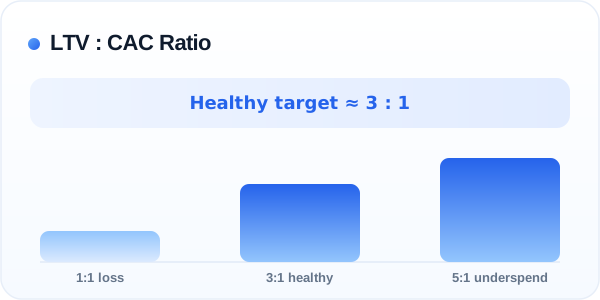
Straight answer: the LTV:CAC ratio compares the lifetime gross profit of a customer to the cost of acquiring them. A ratio of 3:1 is the widely used health benchmark, below it you are spending too much, far above it you may be under-investing in growth.
If there is one number that tells you whether a subscription or repeat-purchase business is built to last, it is this ratio. It is also one of the easiest to fudge, so let us be precise about it.
How to calculate it
LTV here is monthly revenue per customer × gross margin × average lifespan in months. Divide that by CAC and you get the ratio. Crucially, use gross-margin LTV, not revenue LTV, otherwise the ratio flatters you.
Why 3:1?
3:1 leaves enough margin after acquisition to cover overhead, fund growth, and absorb churn surprises. At 1:1 you barely recover acquisition cost. At 10:1 the ratio looks heroic, but it usually means you are too conservative with spend and a competitor will out-grow you. The sweet spot is roughly 3:1 to 5:1.
Do not forget payback period
The ratio ignores time. CAC payback period, how many months of gross profit it takes to recover CAC, tells you the cash-flow story. A great ratio with an 18-month payback can still sink a cash-strapped business. Watch both together.
The LTV:CAC calculator returns the ratio and the payback period side by side.
A worked example
A subscription product charges $50/month at a 80% gross margin, and the average customer stays 24 months. Gross-margin LTV = $50 × 0.80 × 24 = $960. If CAC is $320, the ratio is $960 ÷ $320 = 3:1, right on the healthy benchmark.
Watch what happens if you use the wrong numerator. Revenue LTV ($50 × 24 = $1,200) makes the ratio look like 3.75:1 and tempts you to spend more on acquisition, but that extra $240 is product cost you never keep. The margin-based number is the honest one. And if churn shortens the average life to 12 months, LTV halves to $480 and the ratio collapses to 1.5:1, below break-even territory.
How to read your ratio
| Ratio | What it usually means |
|---|---|
| Below 1:1 | Losing money on every customer, stop and fix unit economics |
| 1:1 – 3:1 | Profitable but thin, little room for overhead or churn surprises |
| 3:1 – 5:1 | The healthy zone, profitable with room to grow |
| Above 5:1 | Often under-investing, a competitor can outspend and outgrow you |
FAQ
Is a higher ratio always better?
No. Above ~5:1 you are likely under-spending on growth.
Where does CAC come from?
See CPA vs CAC for how to calculate it correctly.