CAC payback period explained
Short answer: CAC payback period is how many months it takes for a customer's gross profit to repay what you spent to acquire them. The formula is CAC ÷ (monthly revenue × gross margin).
LTV:CAC tells you whether a customer is profitable eventually. Payback period tells you how fast you get your money back, which is what actually determines whether you can keep funding growth without running out of cash.
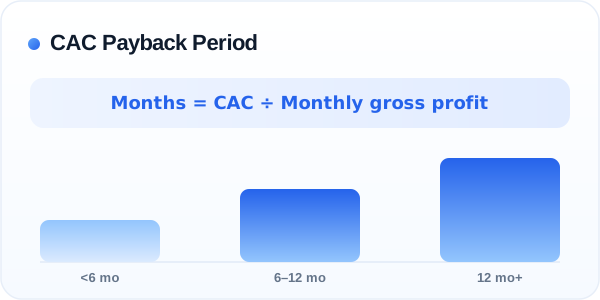
The formula
CAC payback (months) = CAC ÷ (monthly revenue per customer × gross margin). A $300 CAC with $50 in monthly gross profit per customer pays back in 6 months. Run your own numbers in the CPA & CAC calculator.
Why it matters for cash flow
Every new customer is a loan you make to your own growth: you pay the acquisition cost up front and earn it back over time. The longer the payback, the more cash is tied up before it returns, so a fast payback lets you reinvest sooner and scale without external funding.
What counts as good
- Under 12 months, generally healthy for subscription businesses.
- Under 6 months, excellent, and rare outside efficient channels.
- Over 18 months, risky unless you are well capitalized and retention is strong.
Payback period vs LTV:CAC
They are complementary. A healthy LTV:CAC ratio says the customer is worth acquiring; a short payback says you can afford to keep acquiring them now. Strong businesses watch both.
Common mistakes
- Using revenue instead of gross profit. Payback runs on margin, not top-line revenue.
- Ignoring churn. If customers leave before payback, that cohort never breaks even.
- Forgetting it is a cash metric. Profitable-but-slow payback can still starve a growing business of cash.
FAQ
What is CAC payback period?
The number of months for a customer's gross profit to repay their acquisition cost.
What is a good CAC payback period?
Under 12 months is healthy for many subscription businesses; under 6 months is excellent.
How do I calculate CAC payback?
Divide CAC by monthly gross profit per customer (monthly revenue × gross margin).