What is conversion rate?
Bottom line: conversion rate is the percentage of visitors who complete the action you care about. Conversion rate = conversions ÷ visitors × 100. It is the quiet multiplier behind break-even CPC, CPA, and ROAS, small changes here move everything.
Of all the inputs in ad math, conversion rate is the one people under-rate. Marketers obsess over CPC while a half-point lift in conversion rate would do far more for the bottom line. Here is why it matters so much.
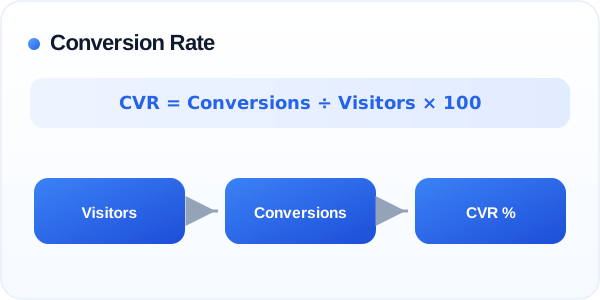
It multiplies through every metric
Break-even CPC = profit per order × conversion rate. CPA = CPC ÷ conversion rate. Raise conversion rate and you simultaneously increase how much you can bid and lower how much each customer costs. No other single input touches both sides at once.
How to improve it
- Match the landing page to the ad’s promise, message mismatch kills conversions.
- Cut page load time; speed is a conversion feature.
- Add trust signals and remove friction from the checkout or form.
See how a conversion-rate change moves your ceiling in the break-even CPC calculator. For a deeper playbook, read how to improve conversion rate.
A worked example: the half-point that beats a CPC war
Take a store with a $1.00 CPC, a 2% conversion rate, and $50 profit per order.
- Today: break-even CPC = $50 × 2% = $1.00. You are exactly at break-even, every click washes out.
- Cut CPC 10% to $0.90 and you finally make $0.10 per click. Hard-won, and competitors can bid it back.
- Instead, lift conversion to 2.5% (a half-point). Break-even CPC jumps to $50 × 2.5% = $1.25. At your unchanged $1.00 CPC you now profit $0.25 per click, more than twice the gain from the CPC fight, and nobody can outbid it away.
That is the multiplier effect: conversion rate raises your bid ceiling and lowers your CPA at the same time. No other input does both.
Typical ranges (use as a sanity check, not a target)
| Context | Rough range |
|---|---|
| Ecommerce (cold paid traffic) | 1–3% |
| Lead-gen landing pages | 3–8% |
| High-intent / branded search | 8–15%+ |
| Display / top-of-funnel | under 1% |
Your own trend beats any benchmark, a page that climbs from 2% to 3% month over month is winning regardless of the industry average.
FAQ
What is a good conversion rate?
It varies by industry and price point. Track your own trend rather than chasing a benchmark. See what is a good conversion rate.
Why use campaign-level rates?
Paid, cold traffic usually converts lower than your sitewide average, use the rate that matches the traffic you are buying.